
How to Fix a Green Pool in Florida, Without Draining It
A swampy green pool looks hopeless, but draining it is almost always the wrong move, and in Florida it can crack your plaster or float the whole shell. Here's the exact recovery process our crew uses to take a pool from pea-soup to swim-ready.
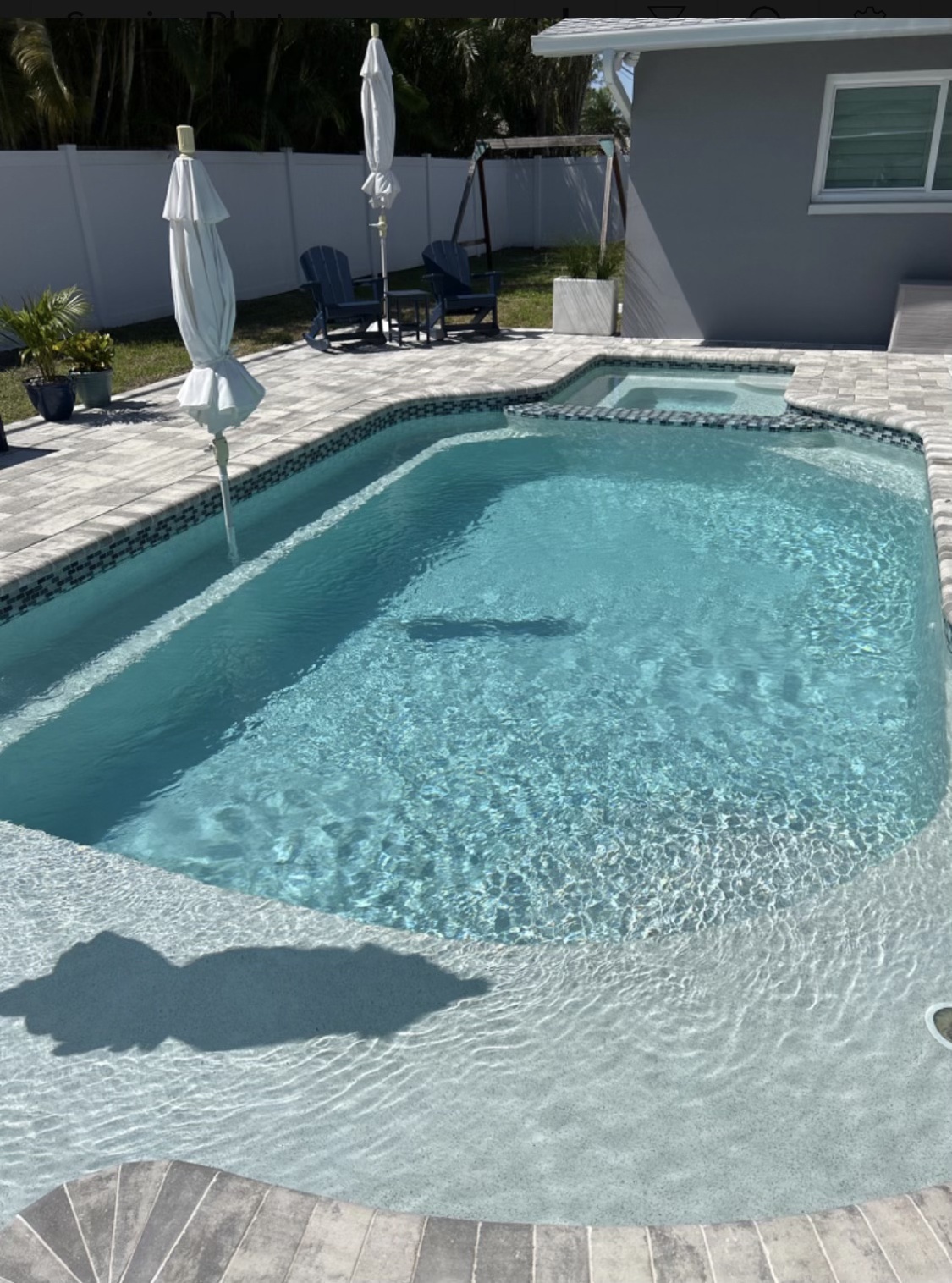
If you pulled the cover off this spring and found a green swamp, take a breath: 95% of green pools are fully recoverable without draining a single gallon. Green water is just an algae bloom, and algae dies fast once you hit it with the right chemistry in the right order. The mistake most homeowners make is tossing in chlorine randomly, seeing a faint improvement, then giving up. Recovery is a sequence, do the steps out of order and you'll waste days and a small fortune in chemicals.
Here's why you should almost never drain a Florida pool to fix algae: our water table is high, and an empty in-ground shell can literally pop out of the ground from hydrostatic pressure after heavy rain. An empty plaster pool also bakes and cracks under the Florida sun within a day. Draining is a true last resort, we cover the few exceptions at the end.
Why Florida pools turn green so fast
Algae needs three things: sunlight, warmth, and food, and Florida hands it all three on a platter. Water temperatures sit in the 80s for months, the UV index torches your chlorine, and every afternoon thunderstorm dumps in phosphates, nitrates, and organic debris. A pool can go from clear to green in under 48 hours if the chlorine bottoms out, usually after a storm, a pump failure, or a week away on vacation.
The most common trigger we see is sunlight burning off unprotected chlorine. Without enough cyanuric acid (CYA, or "stabilizer") to shield it, free chlorine can vanish in a few hours of Florida sun, leaving the door wide open for a bloom.
Step 1, Test before you treat
Never dose blind. If it's opaque pea-soup, dilute a sample 50/50 with distilled water for the CYA and chlorine readings. You're after four numbers:
- Cyanuric acid (CYA): measure this first, it sets your shock target. Aim for 30–50 ppm on a chlorine pool, 60–80 on saltwater.
- pH: target 7.2–7.4. Chlorine is dramatically more effective at lower pH, so this matters more than most people think.
- Total alkalinity (TA): target 80–120 ppm. This buffers your pH so it stops bouncing around.
- Free chlorine (FC): in a green pool this is almost always 0. That's your problem in one number.
Step 2, Balance pH and alkalinity first
This is the step everyone skips, and it's why their shock "doesn't work." If your pH is up at 8.0, a big chunk of the chlorine you add is chemically useless. Bring pH down to about 7.2 with muriatic acid before you shock, and set alkalinity into the 80–120 range so the pH holds. Balance first, then shock, in that order, every time.
Step 3, Shock hard, and shock correctly
"Shocking" means raising free chlorine high enough to kill the bloom and holding it there until the water clears. The target isn't a guess, it's tied to your CYA. As a rule of thumb, drive free chlorine to roughly 40% of your CYA reading and keep it there. A pool with CYA of 40 needs FC pushed to about 16 ppm and held; a pool with CYA of 80 needs far more, which is exactly why sky-high stabilizer makes algae so stubborn.
Use liquid chlorine (sodium hypochlorite) for a fast recovery, it won't pile on CYA or calcium the way pucks and cal-hypo do. Add it with the pump running, late in the day so the sun doesn't immediately burn it off, and re-test and re-dose every few hours until the level holds. Holding the level is the whole game; one big dose that fades by morning accomplishes nothing.
Step 4, Run the filter 24/7 and brush daily
Chlorine kills the algae; your filter removes the dead cells that turn the water from green to cloudy-blue. Run the pump around the clock during recovery and brush the walls and floor at least once a day to knock algae loose where chlorine can reach it. Pay special attention to shady corners, steps, and behind ladders. Clean or backwash the filter whenever pressure climbs, during a heavy bloom you may backwash a sand filter daily, and a cartridge may need rinsing more than once.
Step 5, Clear the last of the cloud
Once chlorine holds overnight and the green is gone, you'll usually be left with cloudy, gray-blue water full of dead algae. A pool clarifier helps your filter grab the fine particles; for a faster finish, a flocculant drops everything to the floor so you can vacuum it straight to waste. Vacuum slowly to avoid stirring it back up, and top the water off afterward.
How long does it take?
- Light green / cloudy: often clear within 24–48 hours.
- Deep green: 3–4 days of holding shock and filtering.
- Black-green swamp: 5–7 days, sometimes with a second flocculant pass.
When to call a pro (or actually drain)
Most green pools are a weekend project. But call a professional, or consider a partial drain, when you see any of these: CYA over 100 ppm that won't come down, black algae rooted into the plaster (it needs aggressive brushing and spot-treating), a bloom that won't clear after a week of properly-held shock, or staining and scaling that point to a deeper chemistry or equipment problem. If your filter or pump can't keep up, no amount of chemistry will finish the job.
Keep it from coming back
Prevention is one habit: never let free chlorine hit zero. Keep CYA in range so the sun can't strip your chlorine, test two to three times a week through summer, run the pump long enough each day to turn the water over, and shock after every heavy storm or pool party. Do that and you'll likely never read this guide twice.
- ▸Don't drain, 95% of green pools recover with chemistry alone.
- ▸Test first; CYA sets your shock target (push FC to ~40% of CYA).
- ▸Balance pH/alkalinity before shocking, or the chlorine is wasted.
- ▸Filter 24/7 and brush daily; clarify or floc to finish.
- ▸Never let chlorine hit zero again, that's the whole prevention plan.